
![[HERO] Trauma & Memory: Why those affected often only remember](https://cdn.marblism.com/xJP6z7fTA11.webp)
⚠️ Trigger warning: This article deals with topics such as child abuse, sexualized violence, trauma and the consequences of trauma. Please only continue reading if you feel stable enough.
“Why are you only saying this now?”
Many abuse survivors are familiar with this question. It comes from relatives, authorities, sometimes even therapists. And it hits home – because it suggests that a late memory is less true. Less valid. Less credible.
The reality is different.
Trauma and memory do not work like a video recorder. The brain stores traumatic experiences differently than everyday events. And sometimes – often even – it buries them so deep that they only reappear years or decades later.
This is not a weakness. It is a survival mechanism.
How the brain protects itself: Dissociation as an emergency program
When a child is abused, something happens in the brain that is called dissociation. The term sounds clinical, but the process is brutally simple: The brain shuts off the memory because it would be too much.
Imagine your nervous system is a fuse box. With normal load, the current flows without any problems. But in the event of a traumatic event – violence, helplessness, fear of death – so much comes in at once that the fuse blows.
The result: The memory is split off. It’s not gone. It is just no longer consciously accessible.
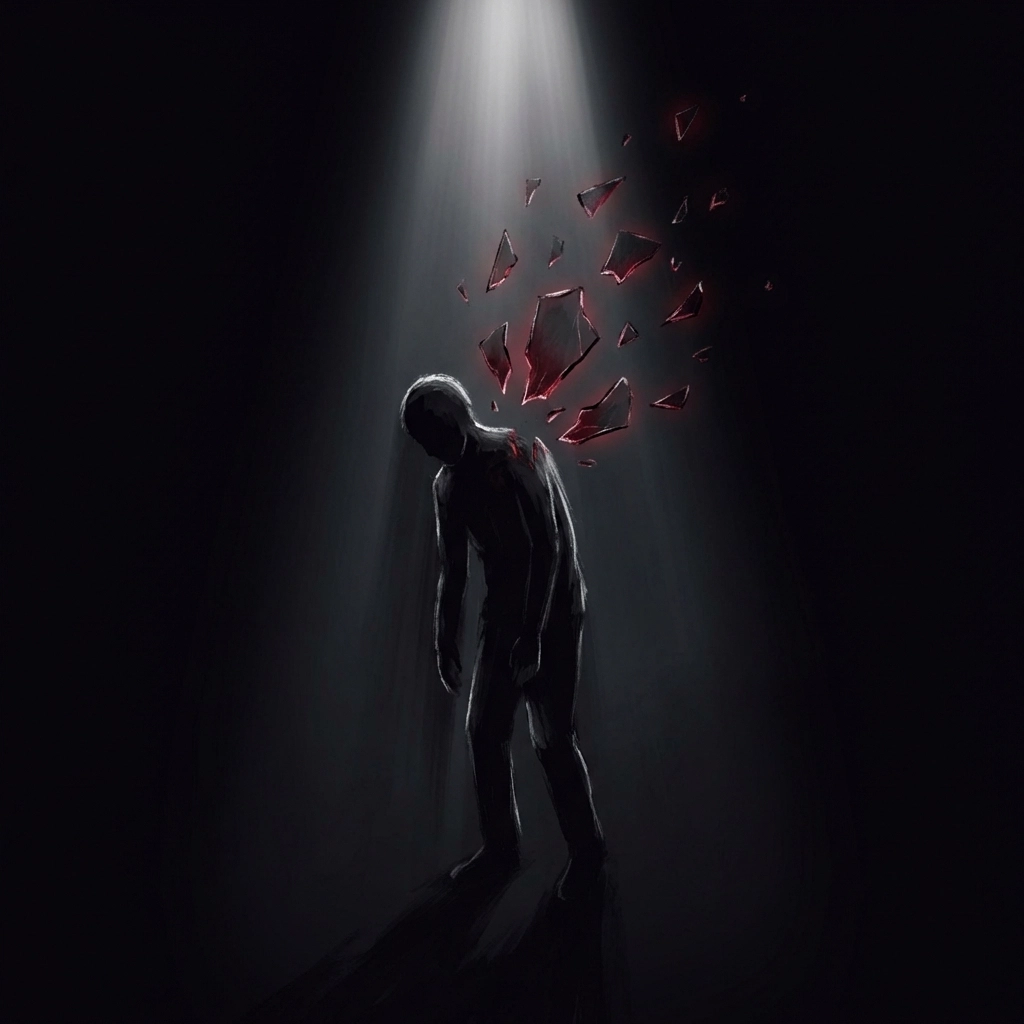
This repression of trauma is not a conscious decision. Nobody wakes up in the morning and thinks: “Today I’ll forget what happened to me.” The brain does this automatically to maintain basic psychological function. Especially in children, whose coping strategies are not yet developed.
Cognitive memory vs. body memory
This is where it gets important – and this is also the reason why many of those affected “function” for years before everything collapses.
The cognitive memory – i.e. what we can consciously access – is often blocked in the event of trauma. The facts, the images, the sequence of events: everything blurred or completely black.
But the body memory remains intact.
This means: The body remembers, even if the head doesn’t. Sudden panic attacks for no apparent reason. Disgust at certain touches. Flashbacks that feel like a punch in the face, but don’t provide a clear picture.
Many of those affected describe it this way: “I always knew something was wrong. I just couldn’t name it.”
In our article Child Abuse Experience Reports: What nobody tells you, we have examined this phenomenon from the perspective of those affected. The patterns are repeated frighteningly often.
Why memories come back later
The question many ask: If the brain locks away the memory – why does it come back at some point?
The answer has several layers.
1. Triggers
Certain stimuli can activate buried memories. A smell. A song. A voice. A situation similar to the original trauma. The brain recognizes the pattern and opens the door – often without warning.
2. Loss of coping structures
Many people manage to push traumatic experiences into the background through work, family or other distractions. But when these structures disappear – due to job loss, separation, illness, retirement – the memories become more present. The mental capacity to keep them away is no longer there.
3. Therapeutic work
In trauma therapy, memories can be worked through in a targeted manner. This is not an “insistence” on experiences, but a careful uncovering of what is already there.

The dissociative amnesia – as the technical term – is reversible. That means: The memories can return. Sometimes in fragments, sometimes as coherent images. Sometimes gently, sometimes like a wave.
The social problem: Credibility and taboo topics
Here we come to a point that has still not arrived in our society.
If someone only remembers abuse later and tells about it, the credibility is often questioned. “You would have thought of that before.” “Maybe you’re imagining it.” “Can you prove that?”
These reactions are not only hurtful – they are dangerous. They prevent those affected from opening up. They cement the silence that protects perpetrators.
The taboo topics of society begin right here: with the refusal to hear uncomfortable truths.
In the German children’s homes of the 60s, abuse was systematic. Many of those affected only spoke about it decades later – not because they didn’t remember it before, but because nobody wanted to listen.
What that means for those affected
If you are affected yourself and are wondering why certain memories are only coming up now: That’s normal. It doesn’t mean you’re crazy. It doesn’t mean you’re imagining something.
It means that your brain protected you back then – and that you may now be strong enough to look.
Trauma consequences manifest differently in every person. Some have clear memories, but cannot talk about them. Others have nothing at all for years and then suddenly everything at once. Both are valid.

What helps:
- Professional support from trauma-sensitive therapists
- Exchange with other affected people (e.g. in self-help groups)
- Knowledge – understanding what is happening in the brain can have a relieving effect
- Time – healing is not a sprint
Conclusion: Late memory is not a false memory
Science agrees: Traumatic memories work differently than normal ones. They can be repressed, split off and reactivated later. This is not proof of incredibility – it is proof of how the human brain reacts under extreme stress.
Anyone who doesn’t believe those affected because they only tell about it “now” has not understood the topic.
And anyone who is affected themselves and is wondering whether their own memories are “real”: Yes, they are. Your body knows it. Your nervous system knows it. And at some point your head will know it too.
On Into the Abyss we write about exactly these topics – without filters, without embellishment. Because silence must not be an option.
A book that doesn’t hide anything
If you would like to deal with the topic of Autobiography Abuse and Trauma Coping, we recommend “Into the Abyss – The True Story of Pussyboy”.
This book is not an easy read. It is an unvarnished account of abuse in German children’s homes, written by someone who experienced it. Raw. Direct. Painfully honest.
Now available as an e-book for €4.99:
👉 Buy Into the Abyss – on Amazon