
![[HERO] From experience report to film: 5 steps to filming a true story](https://cdn.marblism.com/Ng_cAKGWRMs.webp)
The power of images: Why some stories belong on the screen
There are stories that need to be read. And there are stories that need to be seen. Not because words wouldn’t be enough – but because moving images address a different level of perception. They force us to look. They don’t let us turn the page.
The true story film adaptation has experienced a remarkable upswing in recent years. Films such as “Spotlight”, “The Collini Case” or the Netflix documentary “Making a Murderer” have shown that the audience is willing to deal with uncomfortable realities – if they are told authentically and respectfully.
But how does an autobiographical account actually become a film? What steps are necessary to translate trauma and the struggle for survival into a visual medium without diluting the truth or sensationalizing the suffering?
In this article, we show the way from the written word to the cinema screen – and yes: With “Im Abgrund”, the project is already in the starting blocks. The script is finished, director/camera/production are set, and the first actors have already been signed. So it’s not about “maybe someday”, but about the next, real steps towards implementation.
Step 1: The authentic manuscript – The basis of every film adaptation
Every autobiography film adaptation begins with the source material. And this is where the wheat is separated from the chaff. An authentic manuscript is more than a chronological list of events. It is an emotional document that draws the reader into a foreign reality.
In the case of German biographies that deal with topics such as child abuse, institutional failure or social repression, there is another factor: the documentary burden of proof. Court decisions, expert opinions, witness statements – all of this can and should be included in the manuscript.
The Im Abgrund book is based on exactly this foundation. It is not a fictional reworking, but an experience report that is supported by court files and official documents. This authenticity is not only crucial for credibility – it forms the foundation for any serious filmic implementation.

A manuscript that is suitable for a film adaptation must contain the following elements:
- Clear narrative structure with identifiable beginning, conflict and resolution
- Emotional anchor points that can be visually translated
- Documented facts that can withstand legal scrutiny
- Universal themes that point beyond the individual case
Step 2: The filmic vision – Attitude, tone and boundaries (already stands)
The second step is perhaps the most difficult: How do you visualize trauma without turning it into a spectacle? How do you show the reality of abuse without becoming voyeuristic?
The child abuse film adaptation faces an ethical tightrope act. Too explicit depictions can retraumatize and sensationalize. Too restrained depictions risk trivializing the severity of what happened.
What sounds like “artistic decision” in theory is in practice a question of accountability. Therefore, the filmic vision must be in place early – as a guardrail for all departments.
What do we show – and what not?
Successful adaptations such as “The Tale” (2018) or “Mysterious Skin” (2004) have demonstrated how symbolic imagery, changes of perspective and conscious omissions can convey an emotional truth without explicit depictions of violence.
For the Im Abgrund book, this vision means specifically:
- Focus on the victim’s experience, not on the perpetrator’s perspective
- Atmospheric density instead of shocking individual scenes
- Show the aftermath – how trauma shapes an entire life
- Make systemic failure visible – the institutions that looked away
This line is crucial because it later determines the casting, the visual language, the editing and even the music. Without a clear attitude, such material is quickly misunderstood – or watered down.
Step 3: The script – Finished. And now it’s getting serious.
A book is not a script. This realization may sound banal, but it is the reason why so many film adaptations of literature fail. The translation of an autobiographical work into a filmic format requires a fundamental restructuring.
The script acts as the architecture of truth. It decides which scenes remain, which are summarized and which have to fall victim to the filmic compression. A 300-page book must be compressed to 90 to 120 minutes – without losing the essence.
The difference with Im Abgrund: The script is already finished. This is not a “we are working on it”, but a hard milestone. From here, material quickly becomes reality, because you can suddenly plan concretely: shooting days, locations, budget, cast, schedule.
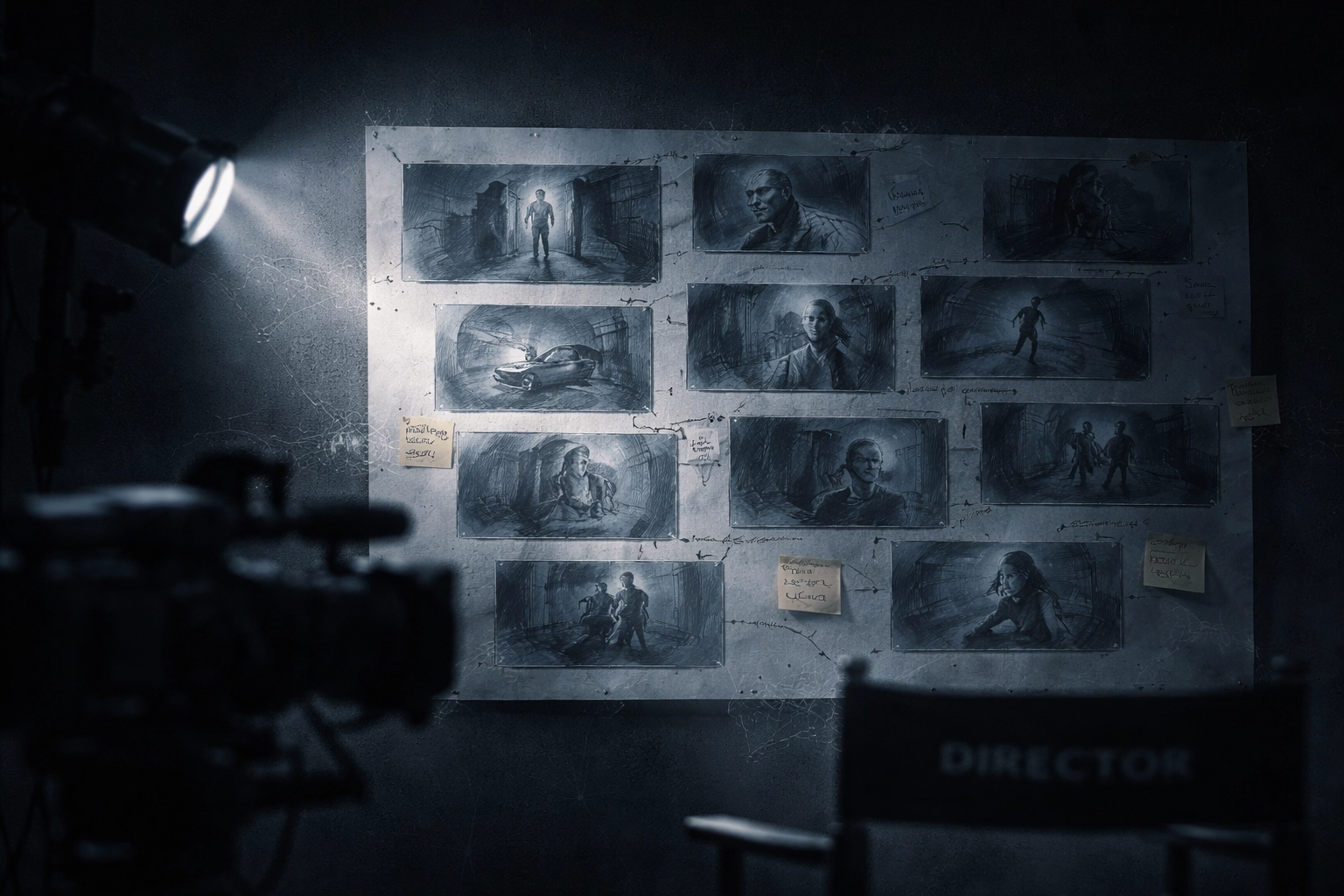
When adapting true stories, there are additional challenges:
- Legal protection: All persons depicted must either have consented or be sufficiently anonymized
- Fact check: Every claim must be verifiable
- Dramaturgical freedom vs. documentary fidelity: How much can be changed?
A good script for an autobiography film adaptation balances these factors. It remains true to the emotional truth, even if individual scenes are rearranged for dramaturgical reasons.
Step 4: Team & Production – The key positions are filled
No film is created in a vacuum. The search for the right people often decides more than any camera. Especially with a material that does not “entertain” but hurts, you need people who can carry the topic – without milking it and without glossing it over.
The German film landscape has certainly shown courage in recent years. Productions such as “Systemsprenger” (2019) or “Die Aussprache” (2022) show that there are filmmakers who face uncomfortable realities.
And here is the current status at Im Abgrund (as of January 2026): Director, camera and production are set. This is the point at which “we are still looking” becomes a setup that can really shoot. From now on, it’s about implementation: scheduling, calculation, shooting schedule, locations, concrete coordination with all trades.
Why this is important: With a child abuse film adaptation, the risks are real – not only financially, but also ethically. Decisions must be clearly justified:
- How do we protect those involved (especially in sensitive scenes)?
- How do we prevent voyeurism without trivializing reality?
- How does the perspective remain clear: Victim experience and systemic responsibility instead of perpetrator myth?
With a standing core team, this attitude can not only be formulated, but implemented – scene by scene.
Step 5: Casting & first commitments – Faces, voices, responsibility
The final step is the one where many projects fail because everything suddenly becomes real: people stand in front of the camera. And with material like this, casting is not just “who fits visually”, but: Who can handle it emotionally – and who tells it with respect?
A film reaches a mass audience. It is discussed in feuilletons, shown at festivals, discussed in schools. It penetrates into social strata that would otherwise never come into contact with the topic. This is precisely why the cast must not be arbitrary.
The history of the true stories film adaptation impressively shows this effect:
- “Spotlight” led to a worldwide debate about abuse in the Catholic Church
- “Natascha Kampusch – 3096 Days” made the topic of child abduction tangible in Germany
- “The Keepers” uncovered decades of covered-up crimes
For Im Abgrund, the following applies (as of January 2026): The first actors have already been signed. This makes it clear: We are no longer in the pure concept phase. The project has momentum – and at the same time, the responsibility increases, because every role conveys an attitude.
Why this counts: Films have the power to break social taboos because they generate emotional empathy. They force us to look. And this looking must be guided – through acting, staging and clear boundaries.
Outlook: What we are now specifically planning with “Im Abgrund”
The question of whether the Im Abgrund book should be filmed is no longer an issue for us. The only question is: how cleanly and uncompromisingly we implement it.
The story of Daniel G. Anders is too important to exist only between book covers. It documents not only individual suffering, but systemic failure – from children’s homes to youth welfare offices to a society that looked away.
And: The project is no longer just pie in the sky. The script is finished. Director, camera and production are set. The first actors have been signed. That means (as of January 2026): We are in the real preparatory work, in which words become shooting schedules.
What is now on the table is the practice:
- Shooting planning (scene breakdown, shooting days, sequence, resources)
- Locations & equipment (finding places that are right without romanticizing)
- Budgeting & financing (calculation, partners, possible funding paths)
- Casting expansion and role work under clear protection and ethical standards
- Legal protection & fact-checking as a fixed production process
The film adaptation will not be an easy task. But it is necessary. Because every true story that is told makes it more difficult to ignore the next.
Conclusion: This is no longer pie in the sky
From experience report to film – this path is long, complex and full of obstacles. But it is passable. The five steps above are not a theoretical “this is how it could run”, but reflect the real status in which we are currently with Im Abgrund.
For us at Im Abgrund, this is not a prestige project. It is work on an uncomfortable truth – and on the question of how a society makes something like this possible and then continues as if nothing had happened.
And because the project is already in the starting blocks (script finished, core team set, first castings decided), it is clear: The story continues. On the screen.
The book “Im Abgrund – Die wahre Geschichte von Pussyboy” is available as an e-book for €4.99 on Amazon. Note: Only suitable for readers aged 18 and over.